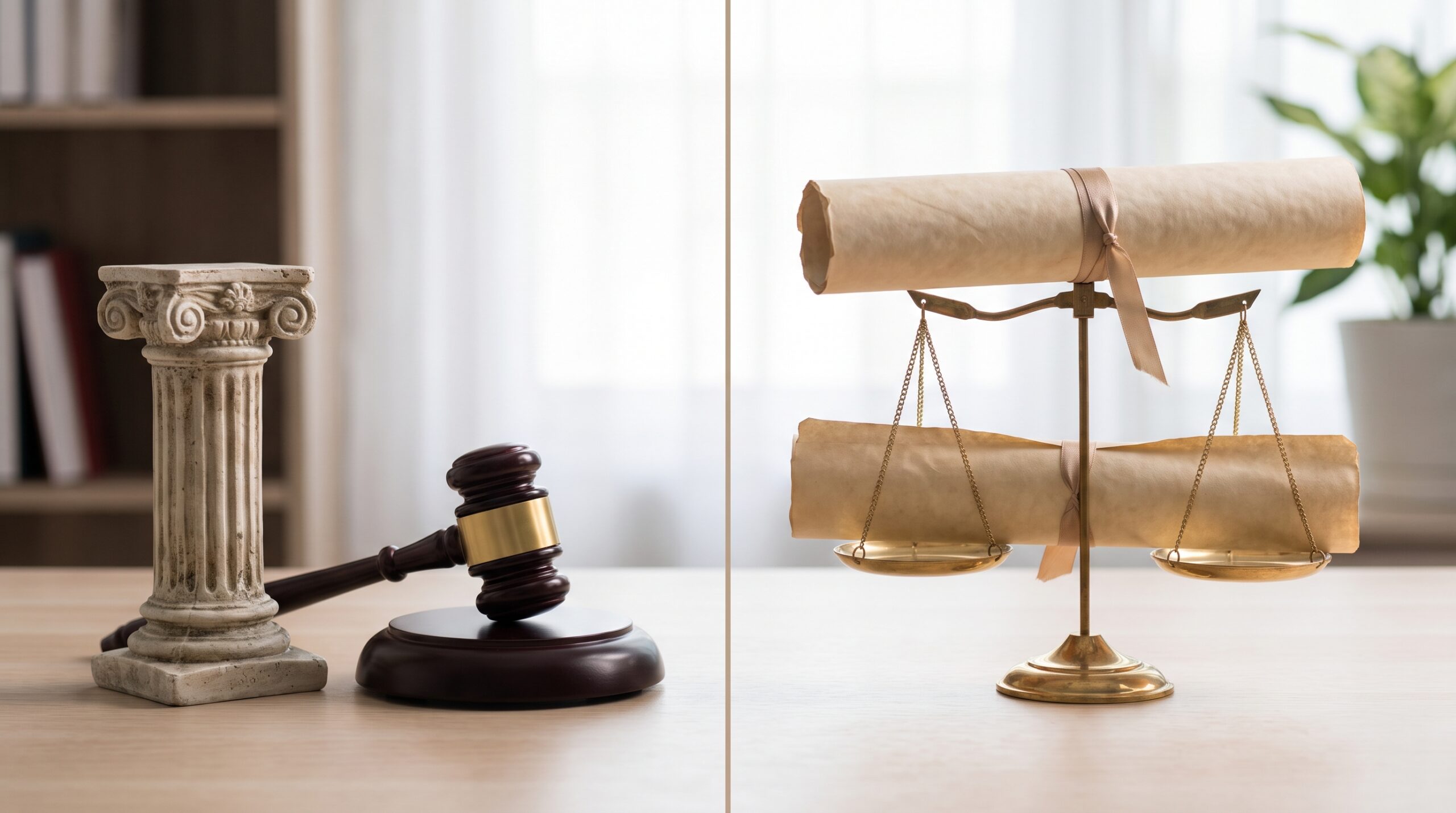
You see two headlines in the same week. One says a driver faces criminal charges after a crash. The other says the injured passenger filed a lawsuit. Both stories involve harm. Both use courts. They are not the same kind of case.
That mix-up is common. People use “sued” and “charged” as if they were interchangeable. They are not. Civil law and criminal law are different toolkits with different goals, different parties, and different stakes. Once you see the split clearly, news stories, contracts, and personal disputes get easier to read.
This guide explains the difference between civil law and criminal law in plain language. It is general education, not advice about your situation. If real money, liberty, or status is on the line, talk to a licensed attorney in your jurisdiction.
The Core Distinction in One Idea
Criminal law treats certain conduct as a wrong against the public. The government prosecutes. The aim is punishment and public protection. Civil law treats disputes as private conflicts about rights and duties. A private party (or sometimes a government acting in a non-criminal capacity) brings the case. The aim is usually compensation or a court order that fixes the problem going forward.
Same facts can feed both systems. A bar fight can bring assault charges and a separate civil claim for medical bills. A fraudulent scheme can bring criminal fraud charges and civil lawsuits from victims. The two tracks ask different questions and can end differently.
Why the Labels Matter
If you think every court case is “criminal,” you will misunderstand the burden of proof, the possible outcomes, and who controls the case. If you think every serious harm automatically means jail, you will misunderstand how personal injury and contract cases work. Clear labels protect you from bad assumptions.
Who Brings the Case?
In a criminal case, the prosecutor represents the government — city, state, or federal, depending on the alleged offense. The injured person may be a witness and may have a voice at sentencing, but they do not “own” the prosecution. The state can continue even if the victim wants to drop it, and the state can dismiss even if the victim wants to push forward.
In a civil case, the plaintiff is the party claiming a right was violated. That is often a person, a business, or an organization. The defendant is the party alleged to be responsible. The plaintiff decides whether to file, settle, or dismiss, subject to procedural rules. You can usually settle a civil claim without needing a prosecutor’s approval.
A Simple Scene
Imagine a rear-end collision. Police may issue a ticket or, in a severe case, bring criminal charges for reckless driving. Separately, the injured driver can sue for medical costs and lost wages. The ticket or criminal case is the public-law response. The lawsuit is the private claim for compensation. Different files. Different goals.
Purpose: Punishment Versus Remedy
Criminal law’s classic purposes include retribution, deterrence, incapacitation, and sometimes rehabilitation. A conviction can mean fines payable to the government, probation, community service, or incarceration. The record itself can follow a person into employment and licensing.
Civil law’s classic purpose is to make the injured party whole, as far as money or court orders can. Damages pay for loss. Injunctions stop ongoing harm. Declaratory judgments clarify rights. Some civil statutes add extra damages or attorney’s fees to encourage enforcement, but the center of gravity remains remedy, not punishment for its own sake.
How This Feels in Real Life
If your neighbor’s tree falls on your garage because they ignored obvious rot, you generally care about repairs and cleanup costs. That is civil thinking. If someone assaults you, you may care about both safety through the criminal process and medical bills through a civil claim. Wanting both is not double-dipping in the moral sense; it is using two systems built for two jobs.
Burden of Proof and What Must Be Shown
Criminal cases require proof beyond a reasonable doubt. That is the highest standard in ordinary American litigation. Jurors must be firmly convinced of guilt. The standard exists because criminal penalties can take liberty and impose lasting stigma.
Civil cases usually require proof by a preponderance of the evidence — roughly, more likely than not. Some civil claims use intermediate standards such as clear and convincing evidence, especially where interests are weighty. The lower typical civil standard is one reason the same story can produce a civil loss for a defendant even after a criminal acquittal, or vice versa depending on evidence and parties.
Evidence Rules Still Matter
A lower burden does not mean “anything goes.” Civil and criminal cases both run on procedural and evidentiary rules. Deadlines, disclosure duties, and admissibility fights shape outcomes long before closing arguments. Beginners often argue only morality. Practitioners also argue what can be proved in the allowed window.
Outcomes: What You Can Win or Lose
Criminal outcomes focus on guilt and sentence. Possible results include dismissal, plea agreement, acquittal, or conviction with sanctions. Collateral consequences — immigration issues, firearm rights, professional licenses — can outweigh the formal sentence in some cases.
Civil outcomes focus on liability and remedy. A defendant may owe money, must return property, or must change behavior under court order. Failure to pay a civil judgment can lead to collection tools such as garnishment or liens, depending on local law. Jail for ordinary contract debt is not the normal civil model in modern U.S. practice, which is one reason people are shocked when they conflate civil and criminal threats.
Settlements and Plea Bargains
Most civil cases settle. Most criminal cases resolve by plea. Trials are expensive and uncertain. Settlement in civil court is a negotiated business decision between parties. A plea deal is a negotiation with the government under different constitutional constraints. Do not treat a civil demand letter as a criminal charge, and do not treat a criminal plea offer as a private bill for damages.
Procedure and Protections
Criminal defendants receive heightened constitutional protections: rights regarding counsel, silence, confrontation, speedy trial, and protection against double jeopardy, among others. The state must follow strict rules because it is deploying public force against an individual.
Civil procedure is still formal, but the atmosphere differs. Parties exchange documents, take depositions, and file motions. There is no “right to a public defender” for ordinary private civil disputes. If you cannot afford a civil lawyer, you may need legal aid, contingency arrangements where allowed, or careful self-representation with eyes open to the risks.
Jurisdiction and Time Limits
Both systems care about where you file and when. Statutes of limitation can bar civil claims. Criminal charging decisions face their own timing rules. Filing in the wrong court wastes months. If you are staring at a deadline, do not rely on memory or social media timelines. Verify the rule that applies to your claim and place.
When Civil and Criminal Law Overlap
Overlap is common in fraud, assault, theft, certain regulatory offenses, and fatal accidents. A criminal conviction can sometimes help a related civil case, though it does not automatically write the civil judgment. A criminal acquittal does not always end civil exposure. Different parties, different burdens, different evidence strategies.
Restitution in a criminal case can look similar to civil damages, yet it is ordered in the criminal process and follows different collection and enforcement paths. Victims should not assume restitution replaces a full civil recovery analysis.
Practical Advice We Give Beginners
If police are involved or you receive charging documents, treat it as a criminal problem first and get criminal-defense counsel quickly. If you receive a summons and complaint captioned as a civil action, treat it as a civil problem with its own deadlines. If both appear at once, coordinate strategy so statements in one forum do not needlessly harm the other. Do not improvise public comments.
How to Read News and Paperwork Without Getting Fooled
When you see “arrested,” think criminal process. When you see “sued,” think civil process. When you see “indicted,” think formal criminal charging by a grand jury in systems that use one. When you see “liable,” you are usually in civil territory. When you see “guilty,” you are in criminal territory.
Demand letters are not warrants. Invoices are not indictments. A viral post saying “this should be illegal” is a moral claim until a legislature and enforcement institutions make it an operable rule. Training your eye on these distinctions is free and immediately useful.
A Quick Self-Check

Ask four questions. Who is bringing the case? What do they want — punishment or remedy? What standard of proof applies? What happens if they win? Those four answers usually tell you whether you are looking at civil law, criminal law, or both.
FAQ
What is the main difference between civil and criminal law?
Criminal law addresses public wrongs through government prosecution and punishment. Civil law addresses private disputes through claims for compensation or court orders.
Can the same act lead to both civil and criminal cases?
Yes. Assault, fraud, and many other fact patterns can trigger both tracks independently.
What does “beyond a reasonable doubt” mean?
It is the high standard of proof used in criminal cases. The decision-maker must be firmly convinced of guilt.
What does “preponderance of the evidence” mean?
It is the usual civil standard: the claim is more likely true than not.
If I am found not guilty, can I still be sued?
Yes. Acquittal does not automatically block a related civil lawsuit.
Do civil cases send people to jail?
Ordinary civil judgments are about money or orders, not imprisonment. Contempt of court is a separate issue and depends on specific circumstances and local law.
Is this article legal advice?
No. It is educational. For advice about your facts, consult a licensed attorney in your jurisdiction.
Two Systems, Two Jobs — Use the Right Lens
Civil law and criminal law both use courts, evidence, and enforceable outcomes. They are still different machines. One centers the government’s power to punish public wrongs. The other centers private rights and remedies between parties. Confusing them leads to panic, false confidence, or both.
Read captions carefully. Match the process to the goal. When the stakes involve your freedom, your home, your business, or your immigration status, get tailored counsel early. Understanding the difference between civil law and criminal law will not replace a lawyer. It will help you hire one for the right problem — and understand what they are fighting about when they do.
Leave a Reply