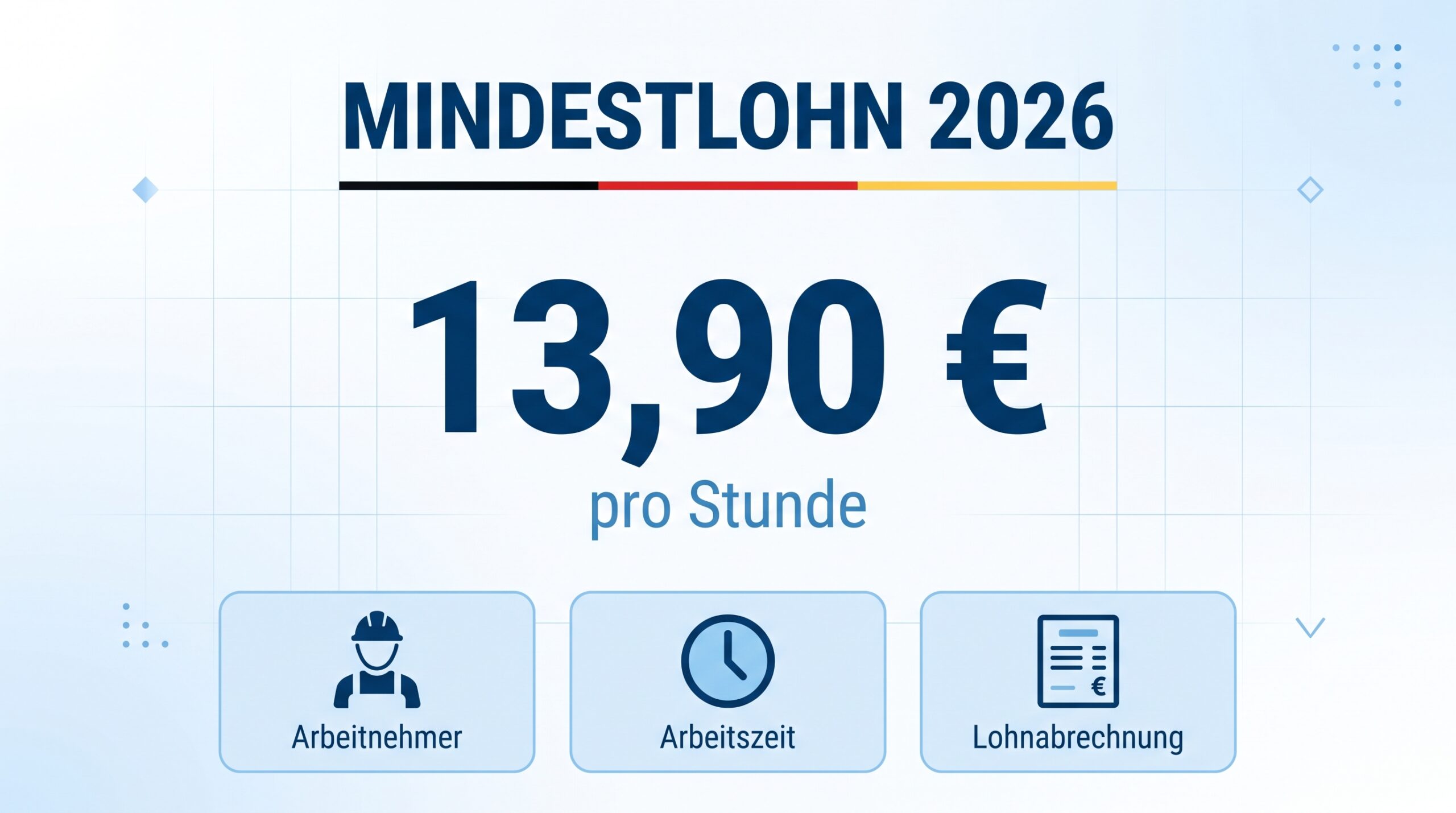
Your payslip arrives and the hourly rate looks familiar—until you check the calendar. Since 1 January 2026 the statutory German minimum wage stands at €13.90 gross per hour. That is a clear step up from the previous level and it affects millions of employment relationships across the country.
The increase is not symbolic. It changes monthly earnings for full-time and part-time staff, reshapes the arithmetic of Minijobs, and places fresh compliance duties on employers. Whether you earn close to the floor or you set wages for a team, the new figure matters. Here is what the Mindestlohn 2026 actually requires and how it plays out in practice.
The New Rate and How It Was Set
Under the Fifth Minimum Wage Adjustment Ordinance (MiLoV5) the statutory minimum wage is €13.90 gross per hour from 1 January 2026. It will rise again to €14.60 from 1 January 2027. The Minimum Wage Commission recommended the two-step path; the federal government implemented it by ordinance under the Mindestlohngesetz (MiLoG).
At a standard 40-hour week the 2026 rate produces roughly €2,407–€2,410 gross per month before tax and social contributions, depending on the exact monthly hours used in the calculation. Part-time and irregular schedules are measured by the actual hours worked. A monthly salary that looks adequate on paper still fails the test if the real hourly rate falls below €13.90.
Who Is Entitled to the Minimum Wage
Almost every employee working in Germany is covered, regardless of nationality, company size or sector. The right applies to full-time, part-time, temporary and marginal workers. Minijobbers are fully included; the hourly floor is the same.
Limited exceptions exist. Young people under 18 who have not completed vocational training, apprentices (who follow separate training allowances), certain compulsory internships, voluntary internships of up to three months for orientation or study purposes, and the long-term unemployed during the first six months of a new job are outside the statutory minimum in defined circumstances. Industry-level minimum wages set by collective agreements or the Posted Workers Act take precedence when they are higher. In cleaning and some other sectors the sectoral rates already sit above €13.90.
Impact on Minijobs and the Midijob Threshold
Because the Minijob earnings limit is linked to the minimum wage, the monthly ceiling rose with it. In 2026 the Minijob threshold stands at €603 per month on average. At €13.90 per hour that allows roughly 43 hours of work per month while remaining inside the marginal-employment regime. Employers and workers who previously calculated hours against the old rate need to recalibrate; exceeding the limit regularly pushes the job into social-security liability.
The Midijob (transition) range also shifted. In 2026 it generally begins just above the Minijob ceiling and runs up to €2,000. Workers in this band pay reduced social contributions on a sliding scale. The higher entry point means some former Minijobbers now sit in the Midijob zone if their hours or rate increased.
What Employers Must Do to Stay Compliant
The minimum wage is calculated on actual hours worked. Employers therefore need reliable time records, especially for flexible, on-call or variable schedules. Section 17 MiLoG imposes documentation duties for many low-wage and marginal relationships; missing or incomplete records make it harder to prove compliance and can trigger fines.
Contracts, payroll systems and scheduling tools should reflect the new hourly floor from the effective date. Retroactive adjustments may be required if January hours were paid at the old rate. Sectoral minimum wages, collective agreements and works-council arrangements that already exceed €13.90 remain binding; the statutory floor is only the lower boundary.
Customs authorities (Zoll) enforce the MiLoG. Inspections can examine payroll, time sheets and contracts. Penalties for underpayment are significant and can include back-pay orders plus administrative fines. Treating the increase as a one-time payroll update rather than an ongoing compliance item invites risk.
Practical Effects for Workers
For someone working 40 hours at the old rate, the rise to €13.90 delivers a noticeable gross increase. Part-time staff and Minijobbers see the change in direct proportion to their hours. Because the Minijob ceiling also moved, many marginal workers can maintain or slightly increase hours without immediately crossing into full social-security coverage.
Workers should check their January and subsequent payslips against actual hours. If the effective hourly rate sits below €13.90, they can raise the issue with the employer, works council or a trade union, or contact the customs authorities. Claims for unpaid minimum wage can reach back several years in many cases, subject to limitation rules.
Looking Ahead to 2027 and Beyond
The second step to €14.60 in 2027 is already fixed. Employers can plan wage budgets and pricing with that figure in view. The Minijob threshold will rise again in parallel, preserving the rough ten-hour-week model that the dynamic link was designed to protect.
The Minimum Wage Commission will continue its regular reviews. Future adjustments will take account of wage developments, the median wage reference and broader economic conditions. For now the path through 2027 is clear: €13.90 in 2026, €14.60 in 2027.
The statutory minimum wage is a floor, not a target. Many sectors and skilled roles sit well above it. For the millions of jobs that operate near the floor, however, the 2026 rate sets a new baseline for contracts, scheduling and household budgets. Workers should verify that their pay meets the hourly standard. Employers should update systems, records and calculations promptly and keep the 2027 step in sight. A clean transition protects both sides and avoids the cost of later corrections.
FAQ
What is the German minimum wage in 2026?
€13.90 gross per hour from 1 January 2026. It rises to €14.60 from 1 January 2027.
Does the minimum wage apply to Minijobs?
Yes. Minijobbers are entitled to the same hourly minimum. The monthly Minijob earnings limit rose to €603 in 2026 so that roughly ten hours per week remain possible at the new rate.
Are there exceptions to the minimum wage?
Limited ones exist for under-18s without completed training, apprentices, certain short internships, and long-term unemployed persons in the first six months of employment. Higher industry minimum wages take precedence when they apply.
How is the monthly equivalent calculated?
At 40 hours per week the 2026 rate produces approximately €2,407–€2,410 gross per month, depending on the precise hours-per-month factor used. Actual entitlement is always based on hours worked times €13.90.
What should employers do now?
Update payroll and contracts to the new rate, ensure time records are accurate, check Minijob and Midijob thresholds, and prepare for the further rise in 2027. Non-compliance can lead to back payments and fines.
Leave a Reply